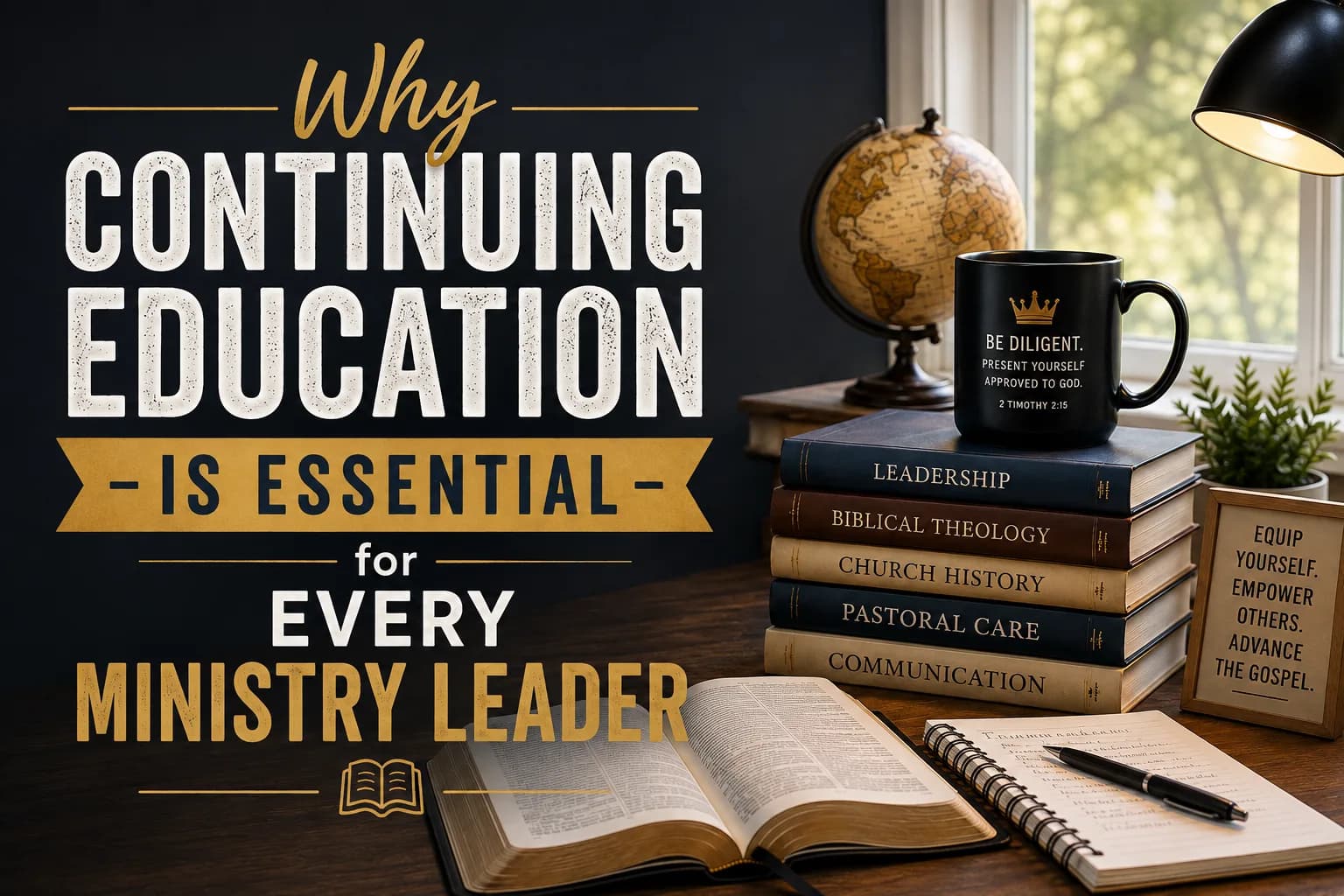
Why Continuing Education Is Essential for Every Ministry Leader
By: Michael J. Decker, M.Min
One of the greatest misconceptions in ministry is the belief that education ends the day a diploma is framed and hung on the office wall. For many Pastor’s, years of rigorous study culminate in graduation from college or seminary, and while no one intentionally decides to stop learning, the relentless pace of ministry often pushes personal development to the margins. Sermons must be prepared, people must be visited, counseling appointments fill the calendar, administrative responsibilities continue to grow, and before long the books that once fueled spiritual and intellectual curiosity remain unopened on the shelf. What was once a passion for learning slowly becomes a casualty of busyness. The irony is that ministry may be one of the few professions where continuing education is more necessary after graduation than before it. While the message of the gospel remains eternally unchanged, the world in which that message is proclaimed changes constantly. Every generation presents new questions, new challenges, and new opportunities for the church. The Pastor who preached effectively twenty years ago cannot assume that the same knowledge, methods, and understanding will adequately equip him or her to shepherd people through today's cultural, technological, and relational complexities. Faithfulness to the gospel does not require us to change the message, but it does require us to continually grow in our ability to communicate that message with wisdom, clarity, and relevance.
Scripture itself presents ministry as a lifelong pursuit of growth rather than a destination of completed knowledge. When the Apostle Paul instructed Timothy to "study to shew thyself approved unto God" (2 Timothy 2:15), he was writing to a young minister who had already received significant theological instruction. Timothy had learned from Paul personally, had been taught the Scriptures by his mother and grandmother, and was already serving in Pastoral leadership. Yet Paul did not assume Timothy had learned enough. Instead, he urged him to continue applying himself diligently to the study of God's Word so that he would rightly divide the truth. That instruction remains just as relevant for Pastor’s today as it was for Timothy nearly two thousand years ago.
One of the greatest gifts a Pastor can offer a congregation is a commitment to personal growth. Every church deserves a shepherd whose understanding of Scripture continues to deepen, whose leadership skills continue to mature, and whose ability to address life's complexities becomes increasingly refined through study and experience. We would hesitate to entrust our physical health to a physician who proudly admitted he or she had not read a single medical journal since graduating decades earlier because we understand that medicine continues to evolve. Likewise, while Biblical truth is unchanging, the questions people bring into the Pastor's office are constantly changing. Today's ministry leaders counsel individuals navigating various addictions, social media pressures, anxiety, depression, blended families, gender confusion, artificial intelligence, economic uncertainty, and countless other realities that require thoughtful, Biblically grounded responses. Continuing education helps ensure that Pastors are prepared to shepherd people through these challenges with wisdom, instead of relying solely on yesterday's experiences.
The pursuit of lifelong learning also protects ministers from one of the greatest dangers in leadership: becoming overly familiar with their own knowledge. There is a subtle temptation in ministry to rely on past successes, familiar sermon outlines, or long-held routines rather than allowing God to continually stretch and challenge us. Yet the more we study Scripture, theology, church history, leadership, counseling, and even disciplines outside the walls of the church, the more we recognize how much there is still to learn. Continuing education cultivates humility because genuine learning consistently reminds us that no matter how many years we have served, we remain students of God's truth. The wisest ministers are rarely those who believe they have all the answers; rather, they are those who never lose their desire to keep asking thoughtful questions and growing in understanding. Far from being a distraction from ministry, continuing education is one of the greatest investments a minister can make in the effectiveness and longevity of their calling. Every book read, every conference attended, every course completed, and every meaningful conversation with other leaders expands the reservoir from which sermons are preached, decisions are made, and people are shepherded. Ministry is too important, the Gospel is too precious, and the needs of God's people are too significant for any Pastor to believe that yesterday's learning will always be sufficient for today's challenges. The calling to preach God's unchanging Word should inspire us to become lifelong learners, continually sharpening our minds so that we may more faithfully serve Christ and His church.
If this Blog speaks to you, you'll find more honest conversations about the realities of ministry in my book, Ministry Unmasked. Order your copy today!